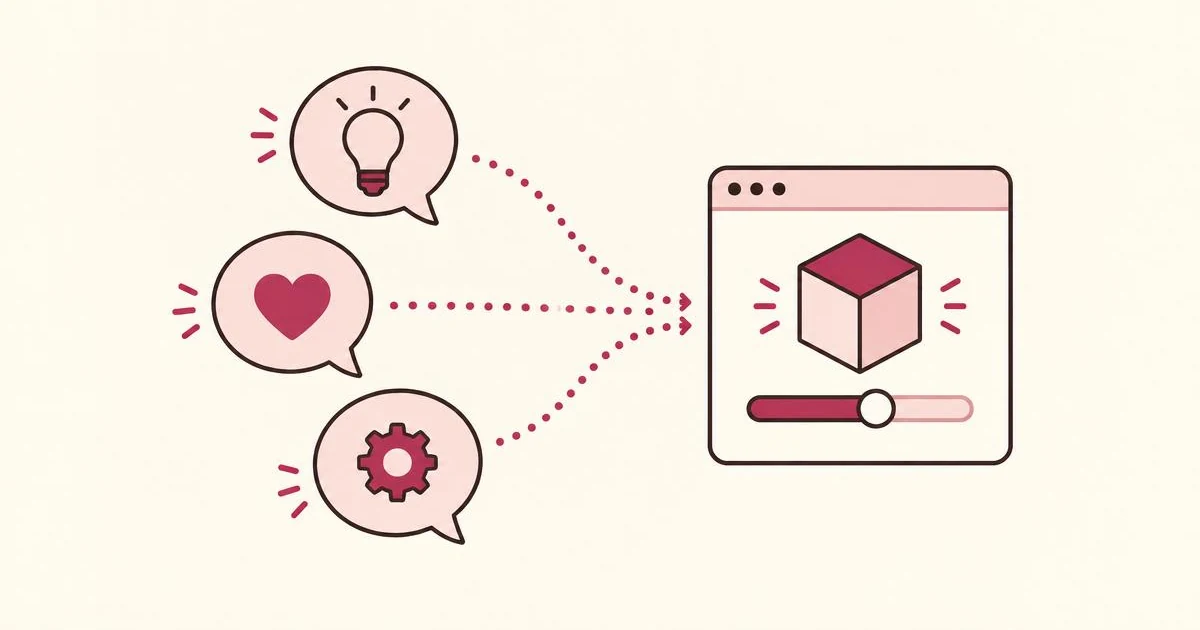
Turn customer requests into a useful test by identifying a shared need, creating a small offer that addresses it, inviting the relevant people, and measuring the outcome.
The objective is to learn whether an offer works before making a larger commitment.
A request helps you choose what to investigate. It does not prove someone will buy.
Start with a requirement, not a broad theme
“More flexible hours” is a theme. “Thursday appointments after 6 p.m.” is a requirement you can design around.
Keep both levels:
- Use themes to see recurring issues.
- Use specific requirements to decide what to test.
Requests about evenings and weekends may belong to the same broad category, but sending both groups an evening-only offer would obscure whether you addressed their actual needs.
Use a simple opportunity brief
Before building anything, write down:
| Field | What to record |
|---|
| Need | The specific change people requested. |
| Evidence | Relevant requests and distinct contacts. |
| Offer | What you can realistically provide. |
| Audience | Whose requirements the offer meets. |
| Success measure | The result that would justify continuing. |
| Cost limit | What you are prepared to spend learning. |
This prevents a popular suggestion from becoming an open-ended project.
A fictional example: testing evening appointments
Suppose a studio receives nine requests for appointments after 6 p.m. Six explicitly mention Thursdays.
The owner proposes one Thursday evening session with four available appointments.
Before sending anything, the owner confirms the price, staffing cost, booking link, and date. They also decide what outcome would justify running another session.
This is a pilot. It can demonstrate operational feasibility and interest among invitees. It cannot, on its own, prove how much demand exists across the whole customer base.
Explain exactly what changed
A useful notification connects the offer to the original request:
“You asked about Thursday evening appointments. We’re testing a session on 19 November, with appointments after 6 p.m.”
Include the real price, availability, and booking link. Use only a channel the recipient agreed to receive updates through.
Do not imply an offer is personalized if it is not, or describe availability as limited unless there is an actual limit.
Measure more than clicks
For the fictional pilot, imagine:
- Six eligible people are invited.
- Five messages are delivered.
- Three people visit the booking page.
- Two book.
- Both attend.
Those are distinct outcomes. Report two bookings among six invitees—not “a 33% conversion rate” without explaining the denominator.
Then consider whether the bookings covered the additional operating cost.
A highly clicked offer with no purchases raises a different question from an offer that was barely delivered.
Understand what the test can prove
Microsoft Research describes controlled online experiments as a way to evaluate ideas through measured comparisons.
Source: Microsoft Research, Online Experimentation at Microsoft
A small offer pilot is not automatically a controlled experiment. Without a comparison group, you cannot confidently attribute every purchase to the notification or claim an incremental sales uplift.
Use pilots to learn whether to continue. Use properly designed comparisons when you need stronger evidence of causation.
Decide what happens next
Choose one of three actions:
Repeat: The offer attracted relevant purchases and was practical to deliver.
Refine: People engaged, but a remaining issue—such as price, timing, or booking complexity—needs investigation.
Stop: The result does not justify the cost, or the offer is not viable.
Record the decision and evidence. Otherwise, the same suggestion may return months later without anyone remembering what was tested.
Frequently asked questions
How many requests are enough to run a test?
There is no universal threshold. A low-cost trial may be worthwhile with a few specific requests; an expensive product change needs stronger evidence.
Where does AI help?
AI can suggest themes, extract details, and draft an opportunity brief. The owner should review the original evidence and approve commercial terms and communications.
Next: Choose better questions for website visitors.
Explore the IfOnly demo to see how an individual request can become an opportunity to investigate.
Research basis: Microsoft Research’s work on controlled experimentation; the studio pilot and numbers are explicitly fictional illustrations. Microsoft Research